
The Art and Science of Signal Spotting
Listening for the future while it is still whispering
feature post by

Hilary Van Welter
CEO
Coralus Member and Founder of Ascentia a Sense, Think and DO Company
At the beginning of Trainspotting, a voice rattles off the now-iconic “Choose life” monologue — a rapid-fire list of what a good life is supposed to look like. But as the words tumble out, something feels off. The script is intact, yet the world it describes has already started to fray. What we are witnessing, in signal-spotting language, is a narrative still speaking long after its underlying reality has shifted. The characters are not without signals. They are swimming in them. But the signals have no place to land, no language to be understood, no field that can metabolize them into something life-giving.
The art and science of signal spotting begin precisely there: in the gap between the stories a system tells about itself and the subtle indicators of the new reality that is already forming underneath.
In other words, we’re trying to sense the landscape we’re in and where new landscapes are possible to emerge — a new field. Signal spotting lives exactly in that sensing. It is how we learn to recognize the faint tremors of a new world before it becomes visible.
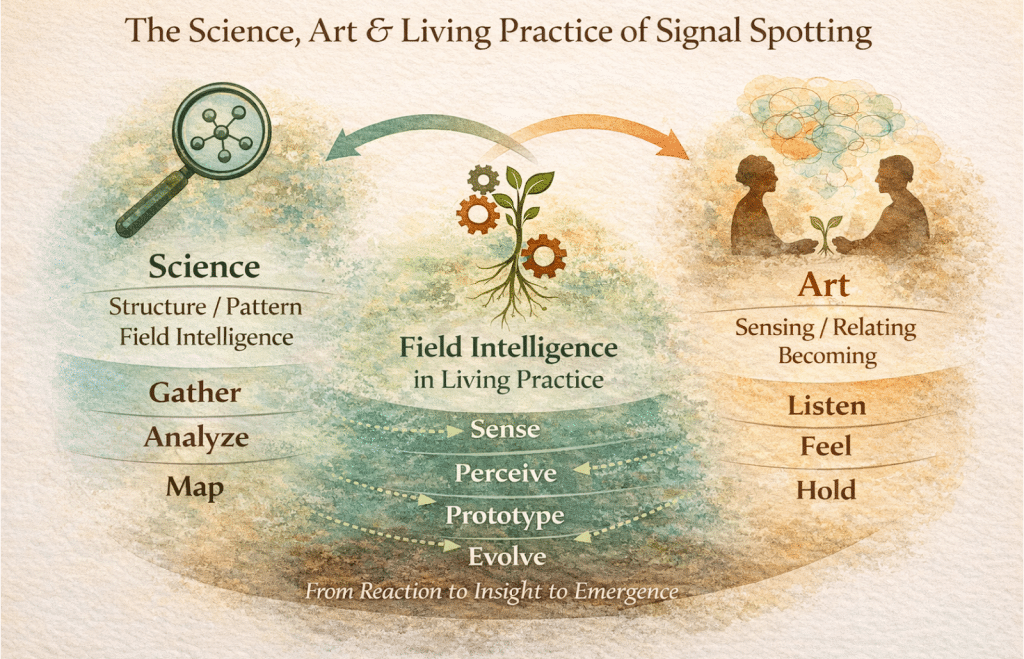
The Science: Structure, Pattern, Field Intelligence
At its most grounded, signal spotting is a structured way of gathering and interpreting early indicators of change. I have been signal spotting since the early ’90s. I remember watching the puzzled faces of the participants at The Manulife Future Forum I was conducting in 1994 as they listened to an MIT professor talk about a world where computers would talk to each other. This, of course, became the Internet. I have fallen down many a rabbit hole following signals that went dead. I have also witnessed those that have evolved into world changing shifts. These all began with a simple signal.
A signal is a small, specific indicator that points toward a larger shift. It might be a founder inventing a workaround, a repeated tension that keeps appearing in conversations, a new phrase that people begin using, or a mismatch between how systems operate and how life actually unfolds.
As an example, when ventures say, “Value is being created, but not recognized,” or “Cash flow doesn’t match our impact cycle,” they are not simply describing their challenges. They are offering data from the edge of a changing system. Each statement is a small flare from the future, illuminating where current structures no longer fit the life they are meant to serve.
The scientific practice then clusters these signals. Patterns begin to emerge. Themes become visible across geographies, sectors, and roles. We begin to see structural misalignments, recurring pressures, and shared innovations. This is the realm of pattern recognition and field intelligence, where signal spotting becomes more than anecdote gathering and turns into a way of reading the direction of a whole system.
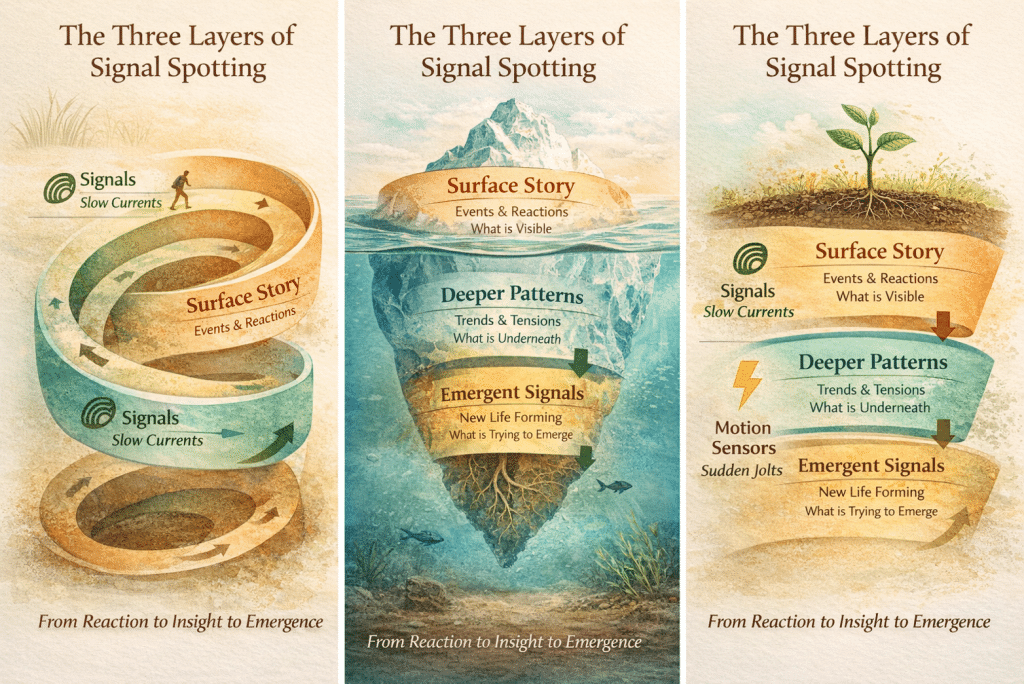
Within this discipline, it is also helpful to distinguish between signals and motion sensors. Signals are slow and directional. They accumulate quietly over time. Motion sensors are sudden events that trigger a spotlight – think Heated Rivalry coming seemingly out of nowhere, bringing energy, emotion, and attention. Together, signals and motion sensors form a kind of nervous system, allowing us to perceive both the slow drift of change and the sudden jolts that accelerate it.
Over time, clusters of signals reveal the conditions required for thriving. In Coralus, these have shown up as the need to move in rhythm with cycles, to secure sustenance aligned with those cycles, and to be resourced through relationships. These are not abstract principles. They are recurring patterns that indicate what a living system requires in order to flourish.
The Art: Sensing, Relating, Becoming
If the science provides the structure, the art of signal spotting provides the depth.
The art begins with a different posture toward reality. Instead of asking only, “What is happening?” we ask, “What is alive here? What is strained? What is trying to be born?”
This requires listening beyond words. Signals are often carried in tone, pauses, contradictions, emotional charge, and in what is not said at all. They show up at the edges of language, where people reach for metaphors because the old vocabulary no longer fits.
It is important to not stay with the first responses – it normally takes 3 ‘rounds’ to get to the source signal – like in the body – skin, subtle level, then bone.
This is why practices like Tea Parties, Moon Calls, and Warm Data spaces matter so much. They soften the surface of conversation and allow deeper sensing to come forward. They make it possible to perceive what the rational mind alone would filter out.
Signal spotting also requires a willingness to stay at the edge. The edge is where something does not fit, where people are improvising, where the system is under pressure. It is where breakdown and breakthrough sit side by side. The edge is not comfortable, but it is generative. It is where the future is rehearsing itself.
And perhaps most importantly, the art of signal spotting requires us to be changed by what we see. The observer is not separate from the field. As in catalytic leadership, the role becomes a conduit, a membrane, a source of relational flow rather than a point of control. Signal spotting asks the same of us. We do not stand outside the system and diagnose it. We listen from within and allow our own perception and action to shift accordingly.
Why It Takes Three Layers to See a True Signal
In practice, meaningful signal spotting almost always requires moving through three layers of perception.
The first layer is the surface story. This is what people say is happening: ‘We’re starting to move in rhythm with the cycles; I don’t feel so alone’. These observations are real, but they are framed within existing language and assumptions. They tell us what is visible, not what is directional.
The second layer is the pattern beneath the story. When we gather many stories together, we begin to see recurring structures. We notice trust networks are functioning as informal infrastructure; founders are relying on relational support to stay viable. Here we are seeing systemic patterns and structural realignments.
But the third layer is where the true signal lives. This is the layer of emergence. Here we ask a different question: What new form of life is trying to organize itself through these tensions?
At this depth, the same observations transform:
- Cash flow mismatch is no longer just a financial problem. It becomes an indication that finance itself must evolve to align with cyclical and seasonal realities.
- Unpaid relational labour is no longer just an inequity. It is a sign that relational capital is trying to become a recognized and exchangeable form of value.
- Founder burnout is no longer only a human resources issue. It signals a shift from heroic, individual leadership to distributed, relational stewardship.
At this third layer, signals are not complaints. They are instructions from the future.
Signal Spotting takes three layers because each requires a different human capacity. The first requires listening. The second requires pattern recognition. The third requires imagination, systems sensing, and the courage to release familiar categories.
Most systems act from the first or second layer and therefore produce incremental responses. Third-layer seeing dissolves the category itself and makes space for something genuinely new.
When Art and Science Meet
When the structure of science and the sensitivity of art are brought together, signal spotting becomes a powerful living practice.
It becomes a field intelligence system, helping us decide where to invest our resources, what to experiment/prototype, what to stop doing, and what new structures are needed.
It becomes a cultural practice, building shared language and distributed sensing capacity across a community.
It becomes a living systems practice, allowing us to perceive both breakdown and breakthrough as part of the same movement of transformation.
And at its deepest level, it becomes a way of becoming a different kind of field ourselves. Because the real purpose of signal spotting is not simply to see the future earlier. It is to become capable of receiving the future that is trying to arrive.
A Working Definition
We might hold it this way:
Signal spotting is the practice of sensing the subtle indicators of how a living system is changing, by listening to patterns of tension, innovation, and emergence, so that new fields of possibility can be recognized and supported as they come into being.
Which one of these diagrams speak to you the most? This is a signal of how you like to spot signals.
Every signal, every story, every experiment becomes part of answering a single living question: are we becoming more alive, more connected, and more resourced over time… or less? When we learn to listen in this way, the future is no longer something that happens to us. It becomes something we recognize, nourish, and midwife into being.
Author

Related Articles


The River Under the River
Alchemical notes from the retreats