The Dance between Practice and Emergence
WRITTEN by

Azul Carolina Duque
Artist & Educator
The most recent retreats we held for Coralus have always lived in the space between two things that, at first glance, can seem like opposites but in fact need each other far more than they let on: structure and emergence.
The practices — the Bus Within Us, Polycrisis and Metacrisis, the Beyond Reform approach, nervous system regulation, rupture and repair — are the part that stayed, the same handful of containers returned to again and again, retreat after retreat, city after city, until they become something closer to muscle memory than instruction.
And yet what happened inside those containers was never the same twice, because it depended on who happened to be in the room, what land we gathered on, what the planets were doing, what the global context of that world was in that particular week, and something harder to name — call it alchemy, call it mystery.
The structure doesn’t compete with the emergence; if anything, it’s the very thing that makes the emergence possible at all, offering a shared frame of reference, a common language, something steady enough to improvise around without having to invent the ground beneath your feet each time.
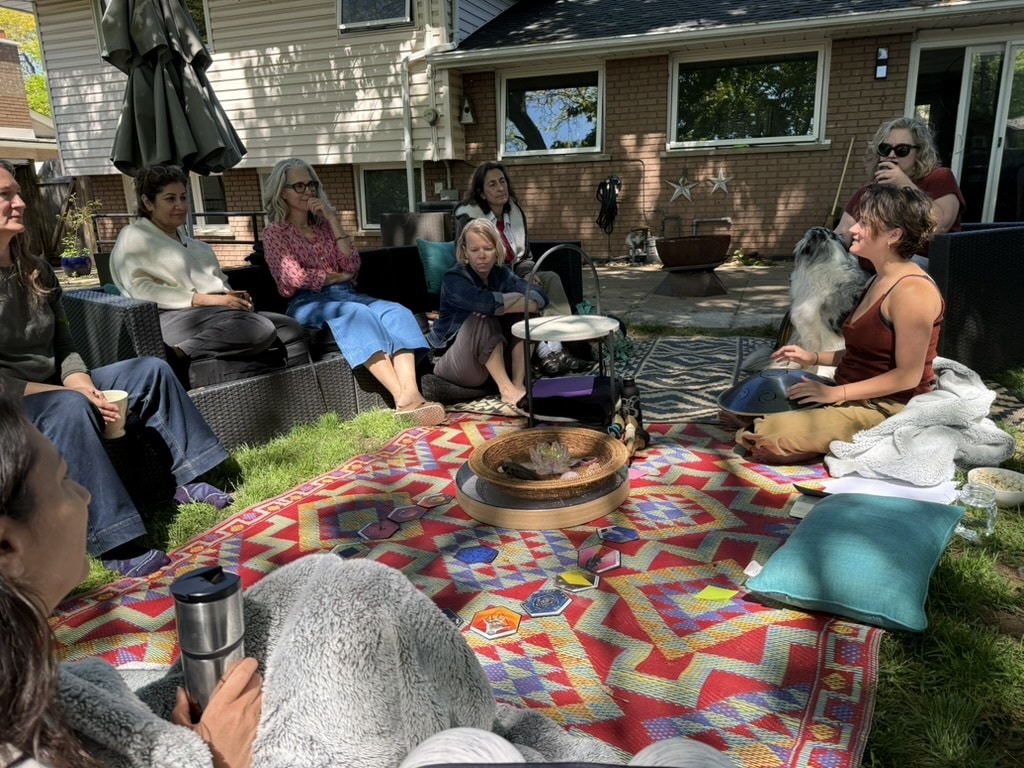
Between early March and June 2026, we hosted roughly fifteen retreats, and I had the privilege of facilitating ten of them.
Across those months, I witnessed an arc that was less linear than cumulative, less a straight line than a kind of sediment: each gathering seemed to leave something behind for the next, some residue of insight or language or trust that the following retreat would then build on without quite realizing it was doing so.
In the beginning, much of the material arrived as theory. Concepts such as shared global context, neurochemistry, energy states, or response-ability, needed language, needed framing, needed careful and patient tending, because people were encountering many of these ideas for the first time, and the work required us to build bridges — slowly, sometimes haltingly — between understanding and practice.
By the middle of the retreat season, something had changed. The field itself seemed to be learning, in a way that was hard to fully account for: we found ourselves needing less explanation and entering more directly into embodied practice.
Sustained eye contact, singing, dancing, silence, sensing, repair, honest and unguarded conversation. The ideas were no longer only being understood.
They were being metabolized. Practiced. Lived.

Rupert Sheldrake’s hypothesis of morphic resonance offers one way to imagine this, suggesting as it does that repeated patterns may become more available through a shared field of memory. Once something has been practiced enough times, it may become easier for others to access, even without direct instruction, almost as though the pattern itself begins to do some of the teaching.
Of course, this is something Indigenous and ancestral communities have been naming for a long time, long before Sheldrake gave it a name of his own: that memory is not only individual, that learning can move through land, body, and relation, (a.k.a. a ‘field’).
Whether we understand this scientifically, relationally, intuitively, ancestrally, or simply as a metaphor for collective learning, something like this appeared to be happening across our own months together.
As a facilitator I noticed how each retreat built on the last, in ways that were often invisible even to those of us inside them. The learning did not stay contained in one room, but moved through the wider Coralus body, the way warmth moves through water without anyone having to carry it.
We were never starting from scratch. Our relationships are never starting from scratch.
And perhaps flocking helps us understand how that happened.
In a murmuration, there is no single lead bird, no centralized control, no one holding the whole map in their head; instead, coherence emerges because each bird pays attention to those nearest to them, makes small and constant adjustments, and allows those movements to ripple outward through the whole, faster than any individual bird could ever track.
But a murmuration is not formless, however much it might look that way from the ground. The birds are following something: simple, repeated patterns of attention that, paradoxically, are precisely what make their freedom of movement possible.
This is part of what allowed the flocking to happen across our retreats: the same practices, returned to again and again, in Toronto and Glastonbury and PEI and online, carried by different facilitators into different rooms full of different people, each time refracted through a slightly different alchemy, and yet underneath all of that variation, the same handful of shared reference points, worn smooth and familiar by repetition.
Without something held in common, there would have been no proximity to sense into, no shared language for a question to travel through, nothing for coherence to cohere around in the first place.
Something similar seemed to be happening across the retreats themselves.
People stayed close to those nearest them, and they added what they could — a story, a question, a song, a challenge, a moment of tenderness, a refusal, a laugh, a rupture, a repair — and then, in ways both formal and subtle, fed something back to the center.
Not the center as the core team.
The center as the murmuration.
The center as the living field of Coralus becoming more able to sense itself.
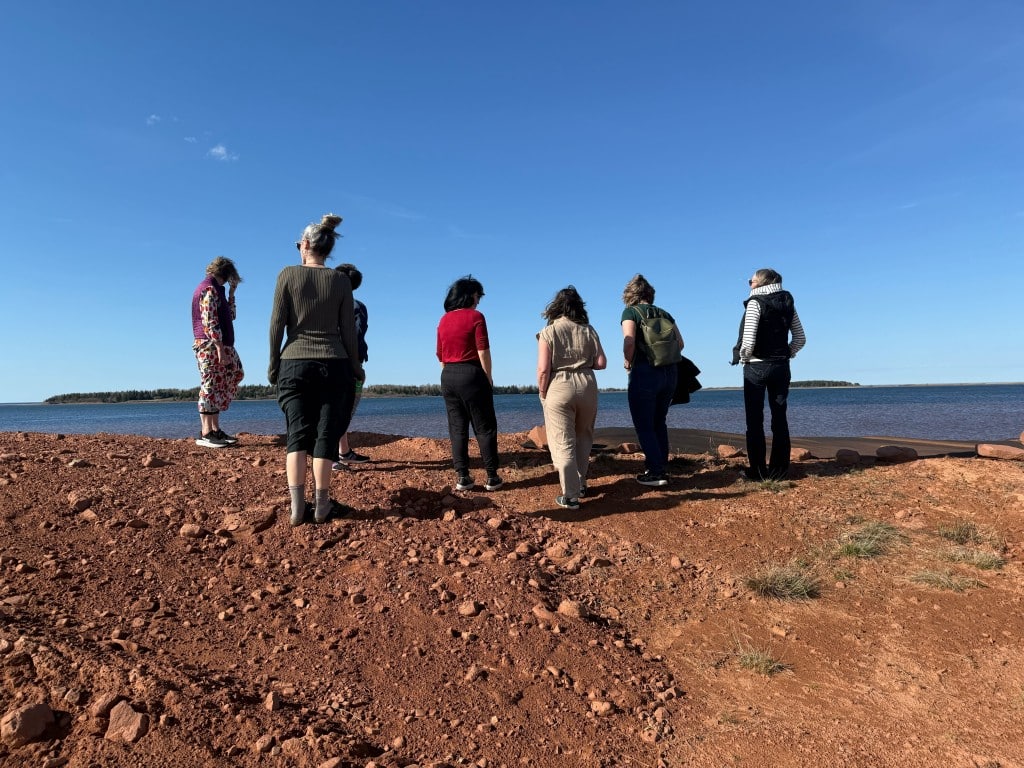
A participant in one city would name a question that reappeared, almost word for word, in another, hundreds of kilometers away, with no one having passed a message between them.
The practice of rupture and repair that felt tender and unfamiliar in March was being applied in real time by participants in June, with a fluency that hadn’t been there before.
A conversation about authority, permission, and responsibility that surfaced in Toronto in early April would echo in Ottawa in late May, but never as a simple repetition, it always had more layers of complexity, more depth, more nuance than the first time it appeared.
The field was not repeating itself mechanically; it was becoming more available to itself with each pass.
This is part of what flocking makes possible: a way of sensing into a field without needing any one person to hold the whole of it, a way of learning through proximity, responsiveness, and feedback, a way of letting coherence emerge through many small acts of attention. Attention that, crucially, had somewhere consistent to land.
As a facilitator, I experienced that by the later retreats, there was a different kind of readiness in the room, gesturing to a general coherence that arrived through all the gathering spaces the community had been tending to: moon calls, co-sensing, signal spotting, flocking, local hostings from community members, etc.
It seemed like these ways of coming together were practiced enough times to begin living in the body of the community itself.
The work had moved from concept to embodied cadence.
From learning about the field to learning as a field.
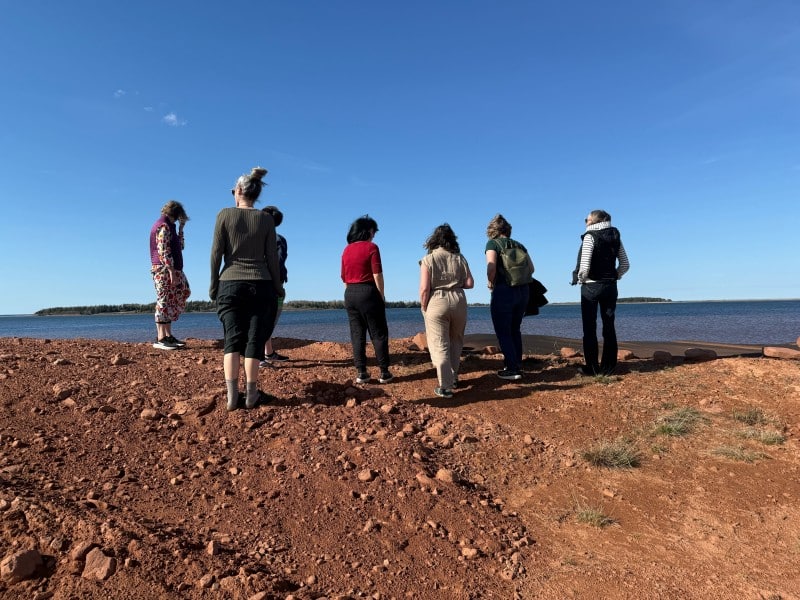
Explore this collection of artifacts, reflections, and visual stories that trace what emerged across the Coralus retreats and what continues to move through the Coralus field.
Author

Related Articles
The River Under the River
Alchemical notes from the retreats

Exploring a Living Tapestry of Gatherings as Emergence
While every retreat shared a common spine, each gathering took on the unique shape of the people, places, nourishment, and relationships that held it. Together, they reveal a living story of the threads already moving through Coralus and the new connections beginning to take shape.