
Welcoming Perception Shift
reflection by

Ariel Brooks
Toronto Cattail Retreat
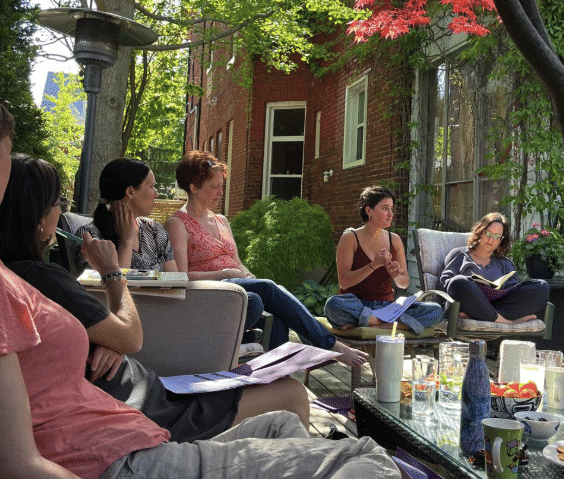
We’re sitting in the backyard of Coralus House in a loose circle around a japanese maple hung with dangling crystals. The background drone is a strange cacophony of nature’s chirps and gusts and bustling Toronto city noise – cars, conversations, construction. It’s early in the retreat, and we’re making direct eye contact with one another across the circle – trying to hold one another’s gaze for 3-5 seconds, and it’s harder than it should be. My face doesn’t know what to do. It wants to smile, but it feels like the motion of crinkling my cheeks gives my eyes permission to dance away when I’m trying to hold steady.
We’re asked to reflect on the way that eye contact stimulates oxytocin in our bodies, which in turn supports “trust, bonding and non-transactional relationships.” Over the course of the afternoon, in between presentation portions, we hum together, dance together, meditate together – each shift an opportunity to listen and connect with parts of ourselves and each other we’re not used to engaging.
At the end, I share, “Isn’t it wild and depressing that these basic technologies of humaning feel like magic because we are so unused to them being parts of day to day life?”
Perception Shift and Practice Shift
Coralus is inviting us into practice shift – evolution towards new ways of being through active experimentation rather than waiting for full comprehension and a clear plan. Almost all of us (if we went through formal schooling and professional training) have been taught that moving emergently is, at best, not strategic, and at worst actively foolish. We’ve also been taught to venerate “mind over matter” and that intellectual roots are the only valid and important ones for idea and path formation.
Recently, more and more voices have been advocating for somatic work, and for the benefits and necessity of strategic adaptation, over long-range linear planning.
The wild fire horse energy of 2026 has certainly required a more flexible approach for my own work and family. My seventh grade daughter has been stressed and stretched by the need to cancel many plans and form others, often driven by things outside our control. She says knowing what is coming is a comforting form of feeling in control. And that “out of control” feels scary.
I was trying to help her to understand that linear planning is the unnatural part – distant from the way organic beings navigate the world around them. Our family’s annual ritual of garlic planting provided a helpful metaphor.
“Every fall we plant garlic, and the garlic’s only plan (it’s north star) is to eventually grow a bulb that could continue to grow more bulbs. But success requires ongoing adaptation – to the temperature and the amount of rain, the quality of sunlight and the number of pests. If the garlic tried to follow a strict timeline that didn’t line up with the conditions of the world, it would likely fail instead of flourishing.”
She eye-rolled a little, well used to my analogies, but nodded too. We’re living through a time of dramatic disruption, when things many of us have taken for granted are now up in question.
As just one example, my daughter is academically inclined, and has always planned to go to college. She is now worried about whether the benefits of going will outweigh the cost, with grade inflation, intense campus politics and AI dramatically transforming the college landscape, and the job market for college graduates rapidly shifting.
I can see that the labor of recalibration is taking an intense toll. Especially when tired, she expresses sadness, frustration and anger that long-held dreams and goals may not make sense. In other moments, I’m grateful for her willingness to listen and integrate new information and ways of looking at things. A few days ago she told me, “I guess if I can’t go to college, I’ll just travel and apprentice and make life-long friends that way instead.”
At 12, my daughter has some advantage of being relatively early in thought-rut formation, but for many of us who have been around the sun a few more times, it can feel like an impossible challenge to unlearn deep-seated ways of thinking about and approaching the world.
Practicing towards new realities gives us rich fodder to form relationships and take action in new ways. It’s one of the best ways I’ve found to move through and beyond sticky patterns and spark insight. (Perhaps my daughter can imagine alternatives to college because she already had the experience of homeschool during the pandemic.)
My inquiry: How can we create a virtuous spiral, integrating our learning into perception shifts – the ability to see and understand things in new ways – that in turn create ease and momentum for our practices?
“Of course we have to shift our strategy frequently in response to changing conditions – that’s how the world works!” – feels a lot better than, “I had everything under control and my plan keeps getting messed up.” (The latter a frequent refrain from earlier versions of myself that finally seems to be loosening its hold as the other narrative becomes more primary.)
At the retreat, we explored some of the new stories and mental models already emerging at Coralus. One that came up strongly was Bayó Akoumalafe’s injunction that: The times are urgent so we must slow down. (Oh, that feels itchy and uncomfortable, but I have been learning over and over how true it is.)
It will be fascinating to begin to name these perception shifts and new stories as we practice, reflect, and re-story together. What else is already coming up for you?

Author

Related Articles

The River Under the River
Alchemical notes from the retreats